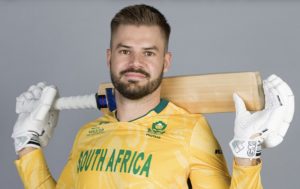
The Women’s World Cup squad was announced on Tuesday, and we caught up with Proteas skipper, Dane van Niekerk, in the latest issue of SA Cricket Magazine.
When teams talk about creating a legacy, they’re usually talking about becoming so good at what they do that their names will be written into the record books.
For the current members of the South African Women’s cricket team,
the legacy they wish to leave is different.
It’s been just over two years since Cricket South Africa increased the number of contracted players from six to 14, and the
team’s performances have been slowly improving.
They recently took the ‘scenic route’ to World Cup qualification, but for captain Dane van Niekerk (right), who took over the reins from Mignon du Preez (far right) last year – it all adds up to the long-term plan.
‘A few years ago, we decided as a team that we want to leave a legacy for women. It’s unbelievable how the game has grown and the exposure that we’re starting to get is all adding to it,’ Van Niekerk explains to SA Cricket magazine.
Qualifying for the World Cup was a bit of a slog. The team failed to finish inside the top four of the ICC Women’s Championship last year, having lost a home series to New Zealand and away to Australia.
Two key players, Shabnim Ismail and Trisha Chetty. were left out of the New Zealand series for disciplinary reasons, and they lost Laura Wolvaardt, Marizanne Kapp, Chloe Tryon and Lara Goodall to injury at various stages, which saw them lose 5-2.
Ismail and Chetty were subsequently suspended until January 2017, meaning they also missed the tour to Australia.
Coach Hilton Moreeng admits that the suspensions were ‘tough’, but even without them, South Africa came agonisingly close to beating Australia for the first time in an ODI.
Losing by two wickets, with just one ball remaining in the first ODI and a tied match prove this was a team on the up, with plenty of talent coming through.
‘I’m so proud of the girls, even if we didn’t win the series against Australia or New Zealand,’ Van Niekerk says. ‘We came very close and it’s important we learn how to take those half-chances, but that’s something that comes with experience.’
These blips meant the side had to go through the World Cup qualifiers in Sri Lanka in February. They finished runners-up in the tournament, having lost twice to India, which included a tense final.
For self-confessed ‘fiery’ character Van Niekerk, those losses have been hard to take. The right-hander is only 23 years old and was thrust into the role last year when Du Preez stood down to focus on her batting.
‘Captaincy has been a big adjustment for me,’ Van Niekerk admits.
‘I can’t always keep a straight face when things go wrong, but it’s forced me to grow up and mature. It’s always been my dream to captain my country, so I am enjoying it.’
But whatever fire she has burning in her belly, she’s clearly using the energy with her bat. Since taking over as captain, Van Niekerk’s average has rocketed to 48.72 from 27.93.
Du Preez, meanwhile, has scored four half-centuries and a century since handing over the role. Transitions as this suggest that there is something special brewing in the camp.
The side has made some tactical changes, too. Sune Luus has provided an extra option at the top of the order, averaging 42.00 in her brief stints as an opener or a No 3, while keeping her bowling average below 21.00.
Lizelle Lee also returned to an opening slot in October last year, having taken a hiatus from the position in 2015.
With the burden of qualifying, and disciplinary issues now behind them, the team can start focusing on the task at hand: the 2017 World Cup. They host India, Ireland and Zimbabwe for a quadrangular series in May and depart for the tournament in mid-June.
The format of the competition is somewhat different to the norm. There are no groups, and instead, all teams play each other, with the top four sides progressing to the semi- finals.
South Africa are targeting a spot in those knockouts, at the very least, and coach and captain agree that the format to get there is something to look forward to.
‘I like the idea of the format where everyone plays everyone and I think that’s more fair. We’re used to playing a lot of games consecutively, so it won’t be too challenging,’ Van Niekerk says.
Australia, whom they have never beaten, and New Zealand, whom they have only beaten twice, and hosts England will be their toughest opponents, but at least the conditions won’t be entirely unfamiliar.
Four South African players featured in the Super League last year – England’s answer to the Women’s Big Bash League. Van Niekerk, Ismail, Kapp and Lee all turned out in the competition, with varying degrees of success.
‘I learned a lot of things about England, like the type of shots you can and can’t play in their conditions. We can all sit together and plan for the types of surfaces we’re likely to play on,’ Van Niekerk says.
While the team has not played an ODI in England since 2008, they did play three T20s there in 2014. At least 10 players who are expected to make the squad featured in that series.
The team also toured Ireland last year, where they won 3-1. Moreeng believes this was a good initiation for players who had not experienced the UK conditions in all its frigid glory.
‘The tour to Ireland last year helped us get used to the conditions too. It was cold, it rained, it was windy, it was really tough. But we went through that with our heads held high and we were successful. But the weather is not something we can control, if we come up against that – and if we have to deal with adjusted targets because of rain – that’s just something we’ll have to deal with when it happens,’ he says.
The parameters for success have also been laid out quite clearly. Anything less than a semi-final berth will be deemed a failure. At the last edition, the team managed just two wins from seven games as they crashed out in the Super Sixes stage.
But that was four years ago and much has changed since then, even if no fewer than six players who are likely to make the squad featured in that tournament.
More money, allowing the players to focus on playing cricket for a living, as well as CSA making the side part of their annual high-performance academies, means skills can be refined and focus defined.
With the women’s game following the men’s in becoming more global – with more leagues and more regular fixtures – it also means players are more familiar with each other and they have far more experience than ever before.
South Africa might still be some way off regularly challenging countries like Australia and England – where professional cricket structures for women have existed for nearly a decade – but at least they are making inroads into setting the foundations for future generations.
Words: Antoinette Muller